



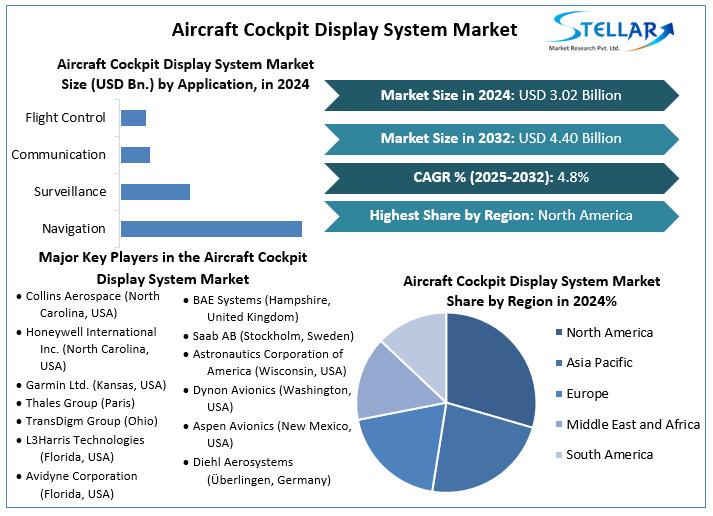
Aircraft Cockpit Display System Market Size To Grow At A CAGR Of 4.8% In The Forecast Period Of 2025-2032
Aircraft Cockpit Display System Market Soars: Innovation & Safety Driving Growth
Market Estimation & Definition
Aircraft cockpit display systems (CDS) are advanced avionics solutions that provide pilots with real-time flight data, navigation information, weather updates, and critical system alerts through integrated digital displays. Replacing traditional analog gauges, modern cockpit display systems enhance situational awareness, flight safety, and operational efficiency in commercial, military, and general aviation aircraft.
The global aircraft cockpit display system market encompasses primary flight displays (PFDs), multi-function displays (MFDs), electronic flight instrument systems (EFIS), head-up displays (HUDs), and touch-based interface modules. Increasing adoption of digital avionics, rising commercial and defense aircraft production, and stringent safety regulations are driving strong market growth.
Request Free sample Report:https://www.stellarmr.com/report/req_sample/Aircraft-Cockpit-Display-System-Market/1993
Market Growth Drivers & Opportunities
1. Growth in Commercial Aircraft Fleet
The rising number of commercial flights and expansion of global airline fleets have boosted demand for cockpit display systems. Airlines are investing in next-generation avionics to enhance operational efficiency, reduce pilot workload, and ensure adherence to global aviation safety standards.
2. Advancements in Digital Avionics
Transition from analog to digital display systems has led to demand for EFIS, HUDs, and multifunction displays, offering better integration, high-resolution imaging, and enhanced navigation capabilities. Advanced avionics systems improve situational awareness and safety in all flight phases.
3. Defense and Military Aircraft Modernization
Modern military aircraft increasingly rely on cockpit display systems for mission-critical operations, tactical awareness, and real-time data integration. Upgrades in fighter jets, transport aircraft, and UAVs are major growth contributors.
4. Enhanced Pilot Efficiency & Reduced Workload
Cockpit display systems streamline information, automate alerts, and integrate multiple data sources into centralized screens, reducing pilot fatigue and improving decision-making under complex flight conditions.
5. Replacement & Retrofit Opportunities
Aging aircraft in both commercial and defense fleets present a lucrative retrofit market, with operators upgrading older analog or outdated digital systems to modern cockpit display solutions.
What Lies Ahead: Emerging Trends Shaping the Future
Touchscreen & Gesture-Based Displays
Next-generation cockpit displays are incorporating touchscreens, gesture controls, and voice commands, enhancing pilot interaction and reducing dependence on traditional physical controls.
Augmented Reality & Enhanced HUDs
Augmented reality overlays on head-up displays provide real-time flight guidance, terrain awareness, and obstacle detection, improving situational awareness and safety.
Integration with Aircraft Data Networks
Advanced cockpit display systems integrate seamlessly with avionics networks, flight management systems (FMS), and electronic flight bags (EFBs), offering centralized access to critical operational data.
Lightweight, Energy-Efficient Displays
Development of lightweight, low-power, and high-resolution displays is crucial for aircraft efficiency, reducing energy consumption and overall aircraft weight.
Cybersecurity & Data Integrity Enhancements
As cockpit systems become more networked, ensuring data integrity and protecting avionics from cyber threats is a key focus for manufacturers and operators.
Expansion in UAVs & Civil Aviation Automation
With the growth of unmanned aerial vehicles (UAVs) and autonomous aircraft, cockpit display systems adapted for remote monitoring and automated flight control are emerging as a significant growth segment.
Segmentation Analysis
Based on typical segmentation in cockpit display system reports:
By Display Type
Primary Flight Displays (PFD)
Multi-Function Displays (MFD)
Head-Up Displays (HUD)
Enhanced Vision Systems (EVS)
Touchscreen / Interactive Displays
By Aircraft Type
Commercial Aircraft (passenger jets, regional jets)
Military Aircraft (fighter jets, transport, trainer aircraft)
General Aviation Aircraft (private jets, helicopters, UAVs)
By Component
Display Screens (LCD, LED, OLED, TFT)
Processors & Graphics Modules
Sensors & Integrated Avionics Units
About us
Phase 3,Navale IT Zone, S.No. 51/2A/2,
Office No. 202, 2nd floor,
Near, Navale Brg,Narhe,
Pune, Maharashtra 411041
[email protected]
Aircraft Cockpit Display System Market Soars: Innovation & Safety Driving Growth
Market Estimation & Definition
Aircraft cockpit display systems (CDS) are advanced avionics solutions that provide pilots with real-time flight data, navigation information, weather updates, and critical system alerts through integrated digital displays. Replacing traditional analog gauges, modern cockpit display systems enhance situational awareness, flight safety, and operational efficiency in commercial, military, and general aviation aircraft.
The global aircraft cockpit display system market encompasses primary flight displays (PFDs), multi-function displays (MFDs), electronic flight instrument systems (EFIS), head-up displays (HUDs), and touch-based interface modules. Increasing adoption of digital avionics, rising commercial and defense aircraft production, and stringent safety regulations are driving strong market growth.
Request Free sample Report:https://www.stellarmr.com/report/req_sample/Aircraft-Cockpit-Display-System-Market/1993
Market Growth Drivers & Opportunities
1. Growth in Commercial Aircraft Fleet
The rising number of commercial flights and expansion of global airline fleets have boosted demand for cockpit display systems. Airlines are investing in next-generation avionics to enhance operational efficiency, reduce pilot workload, and ensure adherence to global aviation safety standards.
2. Advancements in Digital Avionics
Transition from analog to digital display systems has led to demand for EFIS, HUDs, and multifunction displays, offering better integration, high-resolution imaging, and enhanced navigation capabilities. Advanced avionics systems improve situational awareness and safety in all flight phases.
3. Defense and Military Aircraft Modernization
Modern military aircraft increasingly rely on cockpit display systems for mission-critical operations, tactical awareness, and real-time data integration. Upgrades in fighter jets, transport aircraft, and UAVs are major growth contributors.
4. Enhanced Pilot Efficiency & Reduced Workload
Cockpit display systems streamline information, automate alerts, and integrate multiple data sources into centralized screens, reducing pilot fatigue and improving decision-making under complex flight conditions.
5. Replacement & Retrofit Opportunities
Aging aircraft in both commercial and defense fleets present a lucrative retrofit market, with operators upgrading older analog or outdated digital systems to modern cockpit display solutions.
What Lies Ahead: Emerging Trends Shaping the Future
Touchscreen & Gesture-Based Displays
Next-generation cockpit displays are incorporating touchscreens, gesture controls, and voice commands, enhancing pilot interaction and reducing dependence on traditional physical controls.
Augmented Reality & Enhanced HUDs
Augmented reality overlays on head-up displays provide real-time flight guidance, terrain awareness, and obstacle detection, improving situational awareness and safety.
Integration with Aircraft Data Networks
Advanced cockpit display systems integrate seamlessly with avionics networks, flight management systems (FMS), and electronic flight bags (EFBs), offering centralized access to critical operational data.
Lightweight, Energy-Efficient Displays
Development of lightweight, low-power, and high-resolution displays is crucial for aircraft efficiency, reducing energy consumption and overall aircraft weight.
Cybersecurity & Data Integrity Enhancements
As cockpit systems become more networked, ensuring data integrity and protecting avionics from cyber threats is a key focus for manufacturers and operators.
Expansion in UAVs & Civil Aviation Automation
With the growth of unmanned aerial vehicles (UAVs) and autonomous aircraft, cockpit display systems adapted for remote monitoring and automated flight control are emerging as a significant growth segment.
Segmentation Analysis
Based on typical segmentation in cockpit display system reports:
By Display Type
Primary Flight Displays (PFD)
Multi-Function Displays (MFD)
Head-Up Displays (HUD)
Enhanced Vision Systems (EVS)
Touchscreen / Interactive Displays
By Aircraft Type
Commercial Aircraft (passenger jets, regional jets)
Military Aircraft (fighter jets, transport, trainer aircraft)
General Aviation Aircraft (private jets, helicopters, UAVs)
By Component
Display Screens (LCD, LED, OLED, TFT)
Processors & Graphics Modules
Sensors & Integrated Avionics Units
About us
Phase 3,Navale IT Zone, S.No. 51/2A/2,
Office No. 202, 2nd floor,
Near, Navale Brg,Narhe,
Pune, Maharashtra 411041
[email protected]
Aircraft Cockpit Display System Market Size To Grow At A CAGR Of 4.8% In The Forecast Period Of 2025-2032
Aircraft Cockpit Display System Market Soars: Innovation & Safety Driving Growth
Market Estimation & Definition
Aircraft cockpit display systems (CDS) are advanced avionics solutions that provide pilots with real-time flight data, navigation information, weather updates, and critical system alerts through integrated digital displays. Replacing traditional analog gauges, modern cockpit display systems enhance situational awareness, flight safety, and operational efficiency in commercial, military, and general aviation aircraft.
The global aircraft cockpit display system market encompasses primary flight displays (PFDs), multi-function displays (MFDs), electronic flight instrument systems (EFIS), head-up displays (HUDs), and touch-based interface modules. Increasing adoption of digital avionics, rising commercial and defense aircraft production, and stringent safety regulations are driving strong market growth.
Request Free sample Report:https://www.stellarmr.com/report/req_sample/Aircraft-Cockpit-Display-System-Market/1993
Market Growth Drivers & Opportunities
1. Growth in Commercial Aircraft Fleet
The rising number of commercial flights and expansion of global airline fleets have boosted demand for cockpit display systems. Airlines are investing in next-generation avionics to enhance operational efficiency, reduce pilot workload, and ensure adherence to global aviation safety standards.
2. Advancements in Digital Avionics
Transition from analog to digital display systems has led to demand for EFIS, HUDs, and multifunction displays, offering better integration, high-resolution imaging, and enhanced navigation capabilities. Advanced avionics systems improve situational awareness and safety in all flight phases.
3. Defense and Military Aircraft Modernization
Modern military aircraft increasingly rely on cockpit display systems for mission-critical operations, tactical awareness, and real-time data integration. Upgrades in fighter jets, transport aircraft, and UAVs are major growth contributors.
4. Enhanced Pilot Efficiency & Reduced Workload
Cockpit display systems streamline information, automate alerts, and integrate multiple data sources into centralized screens, reducing pilot fatigue and improving decision-making under complex flight conditions.
5. Replacement & Retrofit Opportunities
Aging aircraft in both commercial and defense fleets present a lucrative retrofit market, with operators upgrading older analog or outdated digital systems to modern cockpit display solutions.
What Lies Ahead: Emerging Trends Shaping the Future
Touchscreen & Gesture-Based Displays
Next-generation cockpit displays are incorporating touchscreens, gesture controls, and voice commands, enhancing pilot interaction and reducing dependence on traditional physical controls.
Augmented Reality & Enhanced HUDs
Augmented reality overlays on head-up displays provide real-time flight guidance, terrain awareness, and obstacle detection, improving situational awareness and safety.
Integration with Aircraft Data Networks
Advanced cockpit display systems integrate seamlessly with avionics networks, flight management systems (FMS), and electronic flight bags (EFBs), offering centralized access to critical operational data.
Lightweight, Energy-Efficient Displays
Development of lightweight, low-power, and high-resolution displays is crucial for aircraft efficiency, reducing energy consumption and overall aircraft weight.
Cybersecurity & Data Integrity Enhancements
As cockpit systems become more networked, ensuring data integrity and protecting avionics from cyber threats is a key focus for manufacturers and operators.
Expansion in UAVs & Civil Aviation Automation
With the growth of unmanned aerial vehicles (UAVs) and autonomous aircraft, cockpit display systems adapted for remote monitoring and automated flight control are emerging as a significant growth segment.
Segmentation Analysis
Based on typical segmentation in cockpit display system reports:
By Display Type
Primary Flight Displays (PFD)
Multi-Function Displays (MFD)
Head-Up Displays (HUD)
Enhanced Vision Systems (EVS)
Touchscreen / Interactive Displays
By Aircraft Type
Commercial Aircraft (passenger jets, regional jets)
Military Aircraft (fighter jets, transport, trainer aircraft)
General Aviation Aircraft (private jets, helicopters, UAVs)
By Component
Display Screens (LCD, LED, OLED, TFT)
Processors & Graphics Modules
Sensors & Integrated Avionics Units
About us
Phase 3,Navale IT Zone, S.No. 51/2A/2,
Office No. 202, 2nd floor,
Near, Navale Brg,Narhe,
Pune, Maharashtra 411041
[email protected]
0 Comments
0 Shares
84 Views

 Arabic
 French
 Spanish
 Portuguese
 Deutsch
 Turkish
 Dutch
Dutch
 Italiano
 Russian
 Romaian
 Portuguese (Brazil)
 Greek
Greek